Sunday, April 17, 2011

What's Happening!


is a worldwide leader in developing models of how students develop 21st century problem solving skills. The company's IMMEX™ software assisted learning in more than 150,000 students in classrooms internationally by integrating these multimedia simulations into a unique web-based learning platform for modeling strategic thinking and problem solving. These models help teachers teach, students learn, and administrators make informed educational decisions through the continual, and real-time evaluation problem solving progress. We accomplish this by leveraging existing proprietary libraries of tasks, data sets and advance intelligence-derived performance models, and then extending them with cutting-edge technologies such as second-by-second EEG-derived models of workload, engagement and distraction. During the past five years The Learning Chameleon, Inc. has applied these technologies and developed Team NeuroDynamics. While most people can recognize if a team is in the groove or out of synch, it is more difficult to predict when changes in the state will occur, yet having this ability would be important for dynamically adapting team performance. If we can predict when a team is going out of synch we can provide real-time feedback to help prevent performance errors, lapses in communication or lapses in attention. In this way the company, like its name sake successfully blends within and across educational and assessment environments. Please check out our new website for more information and thank you for your continued support!

Thursday, March 17, 2011

Tuesday, December 7, 2010

The Interservice/Industry Training, Simulation & Education Conference (I/ITSEC)


Dr. Ron Stevens presented: A Neurophysiologic Approach for Studying Team Cognition presentation at this year's Interservice/Industry Training, Simulation and Education Conference, November 29 - December 2, 2010, in Orlando, FL, at the Orange County Convention Center. I/ITSEC is the world’s largest simulation and modeling event. The manuscript was co-authored by Trysha Galloway, Chris Berka and Adrienne Behneman. A copy of the publication may be found here.

Human Factors and Ergonomics Society


Author Dr. Ron Stevens presented: Temporal Sequences of Neurophysiologic Synchronies can Identify Changes in Team Cognition at the 2010 Annual Meeting of the Human Factors and Ergonomics Society held at the Hyatt Regency San Francisco from September 27 through October 1 and was attended by more than 1,590 members and nonmembers from the United States and around the world. The manuscript was co-authored by Chris Berka, Trysha Galloway, and Adrienne Behneman. A copy of the publication is here.

Developing Systems for The Rapid Modeling Of Team Neurodynamics.


During the month of April, the IMMEX team collected data and developed working modules for NS real-time analysis. The development of these generic artificial neural network (ANN) and Hidden Markov Modeling (HMM) models has enabled the construction of web-based software (by Peter Wang) for researchers studying team dynamics where they can submit the individual EEG-E or EEG-WL raw files for three or six members of a team and receive detailed reports showing the dynamics of NS Pattern and NS state expression on a second by second basis. Screen shots of the input and report pages are shown below. While the software is not yet ready for real-time analysis, we should likely have such a version in several months.


Accelerated Learning 2010

In continuation IMMEX’ research as part of DARPA/Defense Science Office’s Accelerated Learning Program, our experts in Team Neurosynchrony collected neurophysiologic indices at The Submarine Learning Center while Junior Officers of the Submarine Officers Advanced Course (SOAC) practiced Submarine Piloting and Navigation (SPAN) simulations. The Submarine Learning Center is accountable for all undersea curriculums, training delivery methodologies, and for developing and maintaining professional development continuums for all undersea warfare.

Changes in Team Neurophysiologic Synchronies During Concept Mapping in Chemistry

As part of a study to determine the broad applicability of using EEG-derived Neuroophysiologic Synchronies(NS) as a measure of team cognition, Trysha Galloway, John Stallings and Peter Wang of the IMMEX team collected neurophysiological baseline and experimental data (using the Advanced Brain Monitoring B-Alert© system) from high school students taught by Master Teacher Marcia Sprang, Ph.D. at Esperanza High School. Two teams of 3 students engaged in a Concept Mapping task on the topic of periodic trends. Their task was to "Develop a concept map for periodic trends of elements and ions that includes the trends and underlying reasons in detail for the trends". We anticipated that there would be periods of brainstorming followed by periods of construction of the concept map, and visual analysis seems to confirm this. The data from these studies is undergoing further analysis and is being incorporated into generic network models.

Friday, December 3, 2010

2010 Behavior Representation in Modeling and Simulation


Dr. Ron Stevens presented: The Identification and Application of Neurophysiologic Synchronies for Studying the Dynamics of Teamwork at the 2010 Behavior Representation in Modeling and Simulation (Brims) annual conference held at Charleston Harbor Resort & Marina in Charleston, South Carolina on March 22-March 25, 2010. Co-Authors on the manuscript are: Trysha Galloway, Chris Berka, and Adrienne Behneman. A copy of the publication may be found under our publications link.

Tuesday, July 27, 2010

IMMEX Site Is Moving

After over 100,000 student participants and nearly a million problem solving performances the IMMEX system is going to be moved from this URL at the end of July. Check back from time to time to IMMEX.COM for future directions of the IMMEX project including the real-time detection and analysis of the neurodynamics of teams.

- Ron Stevens and Team IMMEX

Wednesday, April 21, 2010

Recruiting Research Subjects for the Identification and Application of Neurophysiological Synchronies for Studying the Dynamics of Teamwork

We are currently conducting a research study to measure brain activity, while engaged in problem solving exercises. Specifically electroencephalograph (EEG) indices of attention, workload and visual-spatial memory load will be measured. The objective is to combine simultaneous neurophysiologic signals from team members, to develop pattern categories called neurophysiologic synchronies that can be related to the second-by-second activities of teams. These studies were initiated with funding from the National Science Foundation and DARPA, the results of the research are intended to enhance the training and performance of teams on complex Real-World tasks.
For additional information please contact: Trysha Galloway Email: Trysha@Immex.com

Thank you in advance for considering this request.

Monday, March 1, 2010

BRIMS Paper Accepted


The manuscript titled Identification and Application of Neurophysiologic Synchronies for Studying the Dynamics of Teamwork has been accepted for the 19th Behavior Representation in Modeling & Simulation (BRIMS) Conference which will be held March 22-25, 2010 at the Charleston Harbor Resort and Marina, Charleston, SC.
In this paper we describe a process for collecting and combining neurophysiologic signals derived from individual members of a team to develop pattern categories showing the normalized expression of these signals at each second for the team as a whole. The expression of different neurophysiologic synchrony patterns is sensitive to changes in the behavior of teams over time and perhaps to the level of expertise. The utility and limitations of using this approach are demonstrated for three tasks including a team emotion recall research study, an educational study where teams of high school students solved substance abuse simulations and a complex training study where Submarine Officer Advanced Candidate trainees performed submarine piloting and navigation exercises.
Ron Stevens and Trysha Galloway from the IMMEX Project as well as Chris Berka and Adrienne Behneman from Advanced Brain Monitoring are co-authors of the paper. Once the proceedings are published we will link a copy of the paper at our Publications site.

Monday, December 7, 2009

Learning Trajectories

Authors: Ron Stevens, Carole Beal, and Marcia Sprang had their paper published in the Proceedings of the 17th International Conference on Computers in Education, Hong Kong: Asia-Pacific Society for Computers in Education.

Titled Tracking the Development of Problem Solving Skills with Learning Trajectories this manuscript includes analyses of problem solving approaches for 1,650 chemistry students using multiple measures. The manuscript can be found in our publications list or link here

Wednesday, October 21, 2009

HFES 2009


Ron Stevens, Director of the IMMEX Project will present at a technical session at the Human Factors and Ergonomics Society 53rd Annual Meeting, October 19-23, 2009, San Antonio, TX.
In the session that covers Human Performance Modeling, Ron will present findings on Neurophysiologic Collaboration Patterns During Team Problem Solving.

A copy of the manuscript accepted for publication in the meeting's proceedings can be found at our publications link.

Friday, July 24, 2009

HCI International 2009


Ron Stevens, Director of the IMMEX Project presented at the 13th International Conference on Human-Computer Interaction (July 19-24, San Diego, CA). In the Augmented Cognition category under the topic; Adaptive Instruction, Dr. Stevens presented Can Neurophysiologic Synchronies Provide a Platform for Adapting Team Performance?
The poster session was attended by Trysha Galloway from the IMMEX Project. A scaled version of her poster Can Neurophysiologic Synchronies be Detected During Collaborative Teamwork is available here.

Wednesday, April 29, 2009

IMMEX Tutorials


New tutorials have been created to explain Teacher Registration and the process of Staging a New Class. You may play the tutorials in a java-enabled browser with a Flash player.

Thursday, April 9, 2009

Enhanced Date / Time Display for Improved User Experience


Time Zone Preference
IMMEX recently introduced a new feature that allows the user to specify the preferred time zone when displaying date / time information. This new feature enables the user to visualize data in any specified time zone thus eliminates the need to mentally convert the displayed data from the server time zone. To take advantage of this new feature, go into Settings after logging in and select the preferred Local Time Zone under the Time Zone Option. For a step by step guide on how to change your Time Zone preference, see the Step-by-step Guide To Changing Time Zone Preference.

Thursday, January 22, 2009

PROBLEM SET OF THE MONTH - January 2009


RXN
Periodically IMMEX will highlight a problem set that has significant research data and/or potential.
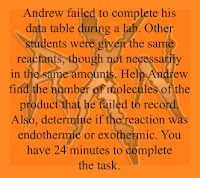
RXN is a chemistry problem (RXN stands for reaction). Use your knowledge of Endothermic and Exothermic reactions to balance chemical equations, interpret particulate diagrams, determine ratios, and solve for unknowns.
To see the Prolem Profile, Statistics, Interactive Data, and more click here.

Tuesday, December 30, 2008

Data Downloads Available In Digital Dashboard

A new update of IMMEX has just been released. The update is automatically applied when you log in. You will not have to do anything to take advantage of this new update.

This new update brings you the ability to download QuadScore data when using the Digital Dashboard. For a brief overview and tutorial of the IMMEX Digital Dashboard, please click on the icon on the left or use this link

Sunday, November 2, 2008

PROBLEM SET OF THE MONTH - November 2008


Which Plasmid is It?
Each month IMMEX will highlight a problem set that has significant research data and/or potential.
You need to use molecular biology techniques to determine which plasmid is in the container. From your lab book and invoices you know what the possible plasmids are.
While using the provided "Student Guide", the student takes notes on the various characteristics of the particular plasmid, including antibiotic resistance and restriction sites. Using data from the digests the student puts together a profile of the plasmid and uses an elimination strategy to determine the solution to the problem.
To see the Prolem Profile, Statistics, Interactive Data, and more click here.

Thursday, October 2, 2008

PROBLEM SET OF THE MONTH - October 2008


HAZMAT
Each month IMMEX will highlight a problem set that has significant research data and/or potential.
This month's selection is designed for high school, and freshman level chemistry students.
Hazmat, is a qualitative analysis problem, in which the student must identify an unknown compound based on the results of the physical and chemical tests that s/he requests within the problem space.
A volume of research findings has been published and/or presented on the data collected from this versitle problem set.
To see the Prolem Profile, Statistics, Interactive Data, and more click here.